The Heckman Equation Project is supported by the Irving Harris Foundation, The Children's Initiative: A Project of the J.B. and M.K. Pritzker Family Foundation, the McCormick Foundation, and an anonymous funder.
|
|
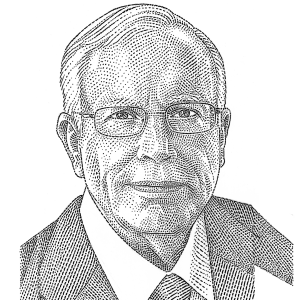
James J. Heckman is the Henry Schultz Distinguished Service Professor of Economics at The University of Chicago, a Nobel Memorial Prize winner in Economics, and an expert in the economics of human development. His groundbreaking work with a consortium of economists, developmental psychologists, sociologists, statisticians and neuroscientists has proven that the quality of early childhood development heavily influences health, economic and social outcomes for individuals and society at large. Heckman has proven that there are great economic gains to be had by investing in the early childhood development.
Download: About Heckman or Complete CV
|
|
James Heckman received his B.A. in mathematics from Colorado College in 1965 and his Ph.D. in economics from Princeton University in 1971. He is currently the Henry Schultz Distinguished Service Professor of Economics at the University of Chicago where he has served since 1973 and where he directs the Economics Research Center and the Center for Social Program Evaluation at the Harris School. He is also the Professor of Science and Society in University College Dublin. He is also a Senior Research Fellow at the American Bar Foundation. Heckman's work has been devoted to the development of a scientific basis for economic policy evaluation, with special emphasis on models of individuals and disaggregated groups, and to the problems and possibilities created by heterogeneity, diversity, and unobserved counterfactual states. In the early 1990s, his pioneering research on the outcomes of people who obtain the GED certificate received national attention. His findings, which found great deficiencies in the alleged value of the degree, spurred debates across the country on the merits of obtaining the certificate.
|
Heckman has received numerous awards for his work, including the John Bates Clark Award of the American Economic Association in 1983, the 2000 Nobel Memorial Prize in Economic Sciences (with Daniel McFadden), the 2005 and 2007 Dennis Aigner Award for Applied Econometrics from the Journal of Econometrics, the 2007 Theodore W. Schultz Award from the American Agricultural Economics Association, the 2005 Jacob Mincer Award for Lifetime Achievement in Labor Economics, and the 2005 Ulysses Medal from the University College Dublin. He is currently Associate Editor of the Journal of Labor Economics. He is also a member of the National Academy of Sciences, and a fellow of the American Academy of Arts and Sciences, the Econometric Society, the Society of Labor Economics, and the American Statistical Association.
|
|
|
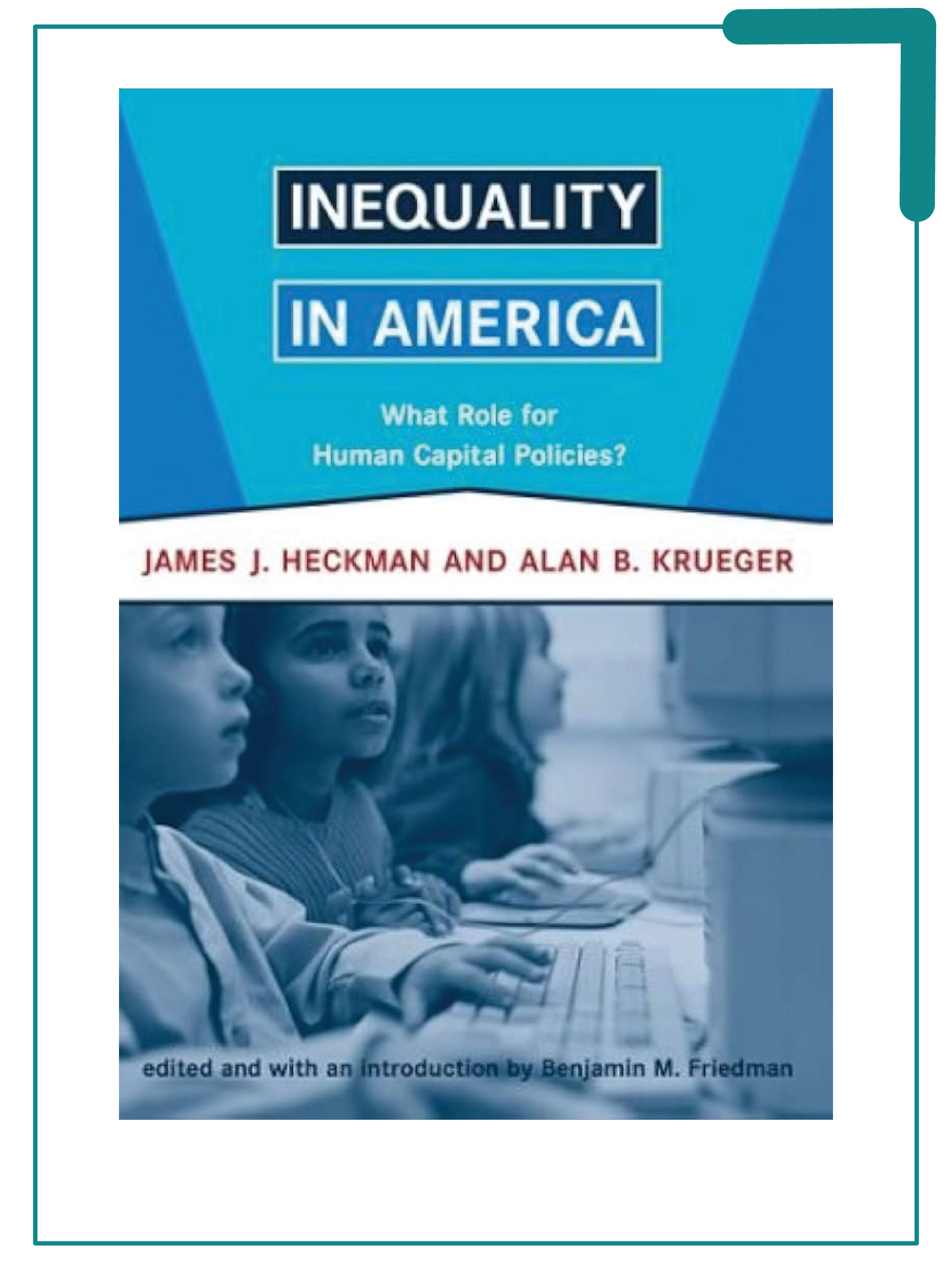
Heckman has published over 200 articles and several books. His most recent books include: Inequality in America: What Role for Human Capital Policy? (with Alan Krueger) and Evaluating Human Capital Policy, and Law and Employment: Lessons From Latin America and the Caribbean (with C. Pages).
|
His recent research focuses on human development and lifecycle skill formation, with a special emphasis on the economics of early childhood development. His research has given policymakers important new insights into such areas as education, job-training programs, minimum-wage legislation, anti-discrimination law, social supports and civil rights.
|
|
|